

A Latin vocabulary for philosophy
Greek philosophy had two centuries of technical vocabulary and Latin had almost none. Much of the wordlist still in use was coined, or given its current sense, in the course of translating it.
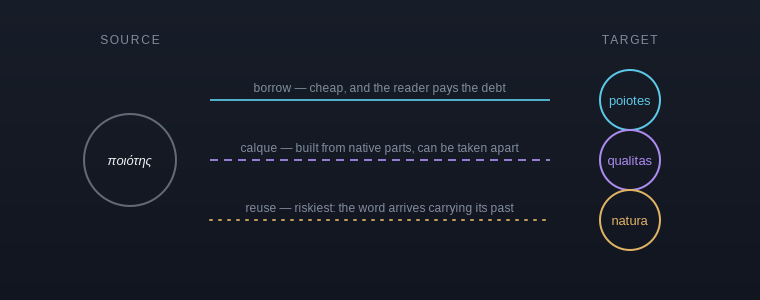
Writing philosophy in Latin in the 40s BC meant inventing most of the words for
it first. Greek had ποιότης; Latin had nothing, so qualitas. The same is
true of essentia, moralis, individuum, evidentia, infinitas — and of
humanitas in the sense everyone now uses.
Why it mattered
The claim in De Finibus is that the language is not the obstacle people say it is: Latin is not poorer than Greek, only less exercised. The proof offered is the book itself.
Two thousand years later the wordlist is load-bearing in every European language, mostly unnoticed, which is roughly the best outcome a translation project can have.
Code
Related papers
- De legibus naturae: praelectio Latine habita
2026 · Conventiculum Arpinas
- Laelius de Amicitia
2021 · to appear
- De Fato: on what is up to us
1942 · Rheinisches Museum für Philologie